Last August, a homeowner in Cumming opened their Georgia Power bill to find a charge exceeding $480 for a single month of cooling. Even with the thermostat set to 72 degrees, their upstairs bedrooms remained stifling, and the attic temperature had climbed to a staggering 150 degrees. This isn't just a comfort issue; it's a clear sign that your roof ventilation is failing to exhaust the trapped heat that bakes your shingles from the inside out.
You already know that the Georgia humidity is a relentless opponent for any property owner. It's frustrating to pay premium rates for electricity while worrying about the invisible threat of mold or wood rot in your rafters. We promise that a correctly balanced system will shield your home from these risks, effectively lowering your cooling demand and preserving your roof's structural integrity. Our team at Supreme Roofing and Reconstruction focuses on meticulous airflow solutions that treat your home as a complete, protected system.
In this guide, we'll demystify the technical differences between ridge vents and power fans so you can make an informed decision for your attic space. You'll learn how a strategic approach to airflow can extend your shingle lifespan by 25 percent and create a more breathable, stress-free environment for your family.
Key Takeaways
- Learn how proper roof ventilation acts as a shield for your Georgia home, preventing "shingle baking" and significantly extending the life of your investment.
- Master the golden rule of a balanced airflow system where intake and exhaust work in perfect harmony to stabilize your home’s internal temperature.
- Uncover the science behind why Atlanta’s 150-degree attic heat is a silent killer for asphalt shingles and how to neutralize it effectively.
- Determine if your property meets the critical 1/300 or 1/150 airflow standards required to satisfy local building codes and maximize efficiency.
- Explore the "Supreme" inspection process that prioritizes your attic’s health to guarantee a truly seamless and long-lasting roof replacement.
The Science of Roof Ventilation in the Georgia Climate
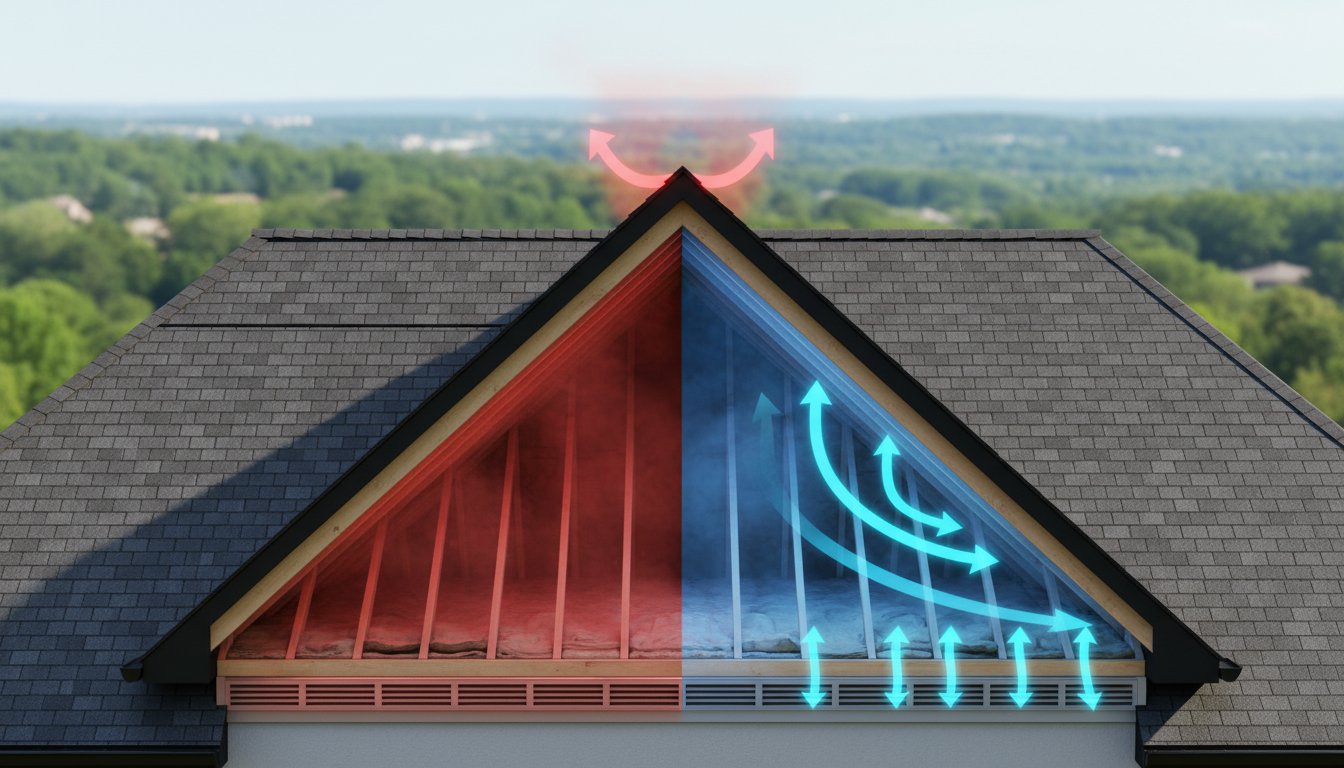
Roof ventilation isn't a passive luxury; it’s a high-performance system designed to maintain a continuous, balanced cycle of intake and exhaust air. Many homeowners in Cumming and the greater Atlanta area fall into the "set it and forget it" trap, assuming their roof functions autonomously once the shingles are nailed down. At Supreme Roofing and Reconstruction, we take the "Expert Protector" approach, viewing your attic’s airflow as a critical defense mechanism for your home’s structural integrity. When Atlanta temperatures hit 90 degrees, an unventilated attic can soar to 150 degrees or higher, effectively baking your shingles from the inside out. The Science of Roof Ventilation relies on thermal buoyancy and wind pressure to flush this trapped heat, protecting your property from premature aging. This system serves two vital roles: purging extreme heat during our sweltering summers and managing moisture during humid Georgia winters.
Why Humidity is the Real Enemy in North Georgia
In North Georgia, humidity often presents a greater threat than the heat itself. When stagnant, moisture-laden air becomes trapped in your attic, it creates a phenomenon known as "attic rain," where condensation forms on rafters and drips onto insulation. This damp environment is a breeding ground for mold and structural wood rot, particularly in older Cumming and Alpharetta homes with outdated ventilation profiles. Stagnant humidity softens the fibers of your roof decking, eventually causing the wood to lose its structural rigidity and sag between the rafters. Proper roof ventilation acts as a constant dehumidifier, moving moist air out before it can settle and compromise your home's skeleton.
The Impact on Your Energy Bills and Comfort
A poorly ventilated attic creates a punishing "oven effect," where the mass of trapped heat radiates through your ceiling and into your living spaces. This forced heat transfer makes your HVAC system work overtime, as it struggles to cool rooms that are being heated from above. In such cases, it is often necessary to explore Air Conditioning Repair to ensure the unit remains operational under the added strain; you can also discover E.R.S. Heating & Cooling to see how industry experts maintain peak efficiency for climate control systems. By optimizing roof ventilation, we reduce the thermal load on your air conditioner during Georgia’s peak summer months. Data from the Department of Energy suggests that heat-reduction strategies like proper airflow can lower monthly cooling costs by 10 to 15 percent. You'll notice the difference immediately in your home's comfort levels and your monthly utility statement.
- Intake: Fresh air enters through soffit or gable vents.
- Exhaust: Hot, moist air exits through ridge vents or attic fans.
- Balance: A 1:1 ratio ensures the system doesn't create a vacuum or pull air from your living space.
Anatomy of a Balanced Ventilation System: Intake vs. Exhaust
A high-performance roof ventilation system operates on a simple, non-negotiable law of physics: the 1:1 ratio. For every cubic foot of hot air that leaves your attic, an equal cubic foot of fresh, cooler air must enter to replace it. At Supreme Roofing and Reconstruction, we define a "Supreme" system by this strict 50/50 balance. If your exhaust exceeds your intake, the system will pull air from your living spaces or even your chimney, which wastes energy and compromises your indoor air quality.
Roofing professionals measure this airflow capacity using Net Free Area (NFA). NFA represents the total unobstructed space through which air can pass, usually measured in square inches. A typical 1,500 square foot attic requires approximately 720 square inches of NFA, split evenly between the top and bottom of the roof. In our humid Georgia climate, failing to meet these specific numbers leads to trapped moisture and premature shingle failure. Most homes we inspect in Cumming fail because they lack adequate intake, not because they lack exhaust.
Intake Vents: The Foundation of Airflow
Intake is the most overlooked component in local homes. We often find older properties where blown-in insulation completely blocks the soffit vents, effectively choking the system. Soffit vents sit under the eaves and pull cool air into the lowest part of the attic. If your home features a contemporary design without wide eaves, we install drip edge or over-the-fascia vents to ensure air still moves upward. You can find more detail on how these components integrate with your home in our Soffit and Fascia Guide.
Exhaust Vents: Letting the Heat Escape
Exhaust vents sit at the highest points of your roof to release rising heat and moisture. Ridge vents are the gold standard for modern roof ventilation because they provide a continuous, low-profile line of exhaust along the entire peak. While many older Marietta neighborhoods still feature static box vents, they are often less efficient because they only vent specific "pockets" of the roof.
One dangerous mistake to avoid is mixing different types of exhaust. Installing a solar power fan alongside a ridge vent creates a "short circuit." The fan will pull air from the nearby ridge vent instead of the soffit vents at the bottom. This leaves the rest of your attic air stagnant and hot. If you aren't sure if your system is fighting itself, our team can provide a professional attic airflow assessment to restore the necessary balance.
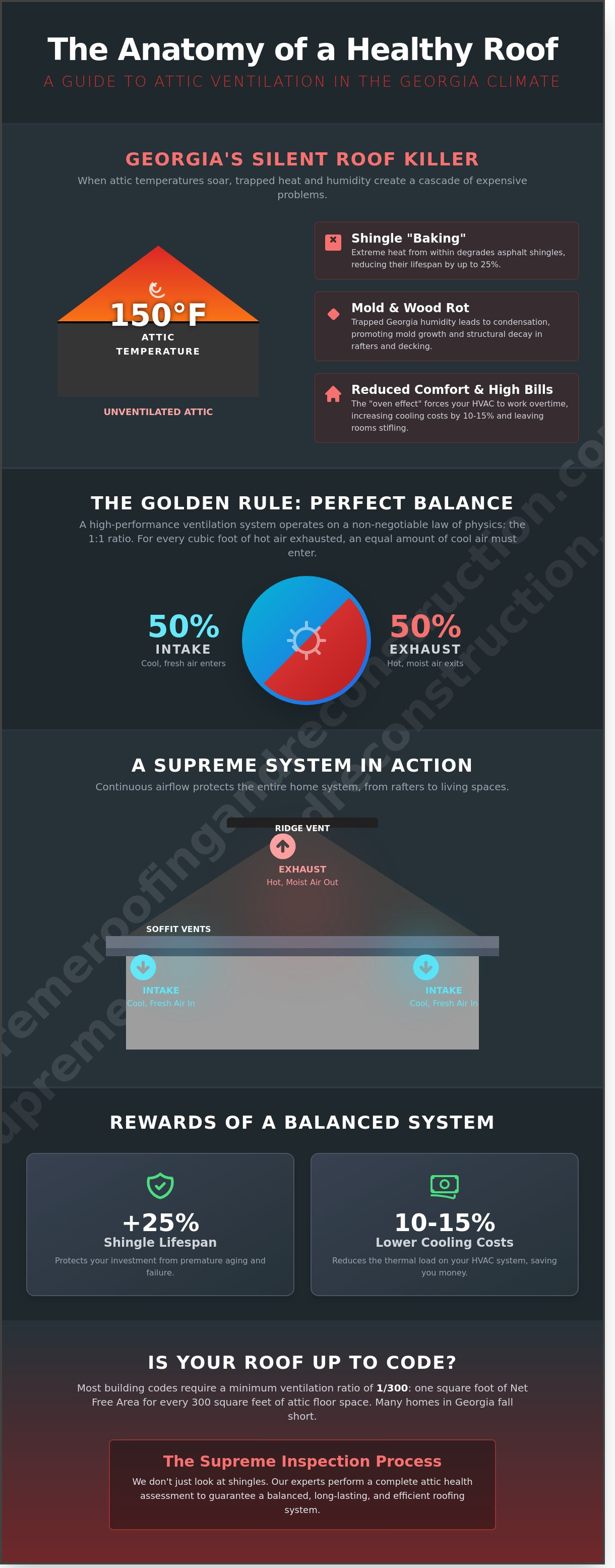
Why Poor Ventilation is Your Roof’s Silent Killer
Many homeowners in Cumming assume that shingles only fail because of a major hail storm or because they reached a specific age. This is a dangerous misconception. While external factors matter, the most common cause of premature roof failure actually happens from the inside out. Without proper roof ventilation, your attic becomes a pressurized oven that destroys your investment day by day.
We call this "shingle baking." When summer temperatures in Georgia hit 95 degrees, an unventilated attic can easily soar past 150 degrees. This extreme heat cooks the asphalt matting of your shingles, making them brittle and prone to cracking. Even high-quality materials can't withstand that level of thermal stress for long. Most major manufacturers will actually void your warranty if they find the installation lacks adequate airflow. As your Expert Protector, our goal is to ensure you never have to make avoidable calls to roof repair contractors for damage that was 100% preventable.
Signs Your Attic is Suffocating
Your roof often displays clear distress signals before a total collapse occurs. In the South, we don't see the same ice dams as northern states, but we see the heat equivalent: massive, premature granule loss. When shingles overheat, the adhesive bond fails, and the protective granules wash into your gutters. You can spot these issues early by performing a quick inspection. Use this checklist during your next walk-through:
- Rusty nails: Look for orange streaks or rusted nail heads on the underside of the roof decking.
- Curling edges: Shingles that cup or claw upward are a primary sign of extreme heat stress.
- Peeling paint: If the exterior paint near your roofline or soffits is bubbling or flaking, trapped heat is likely the culprit.
- Internal temperature: If your upstairs rooms are significantly warmer than the ground floor, your attic is likely holding too much heat.
The Mold and Mildew Threat
Heat is only half the battle. Trapped moisture creates a perfect breeding ground for mold and fungi, which can compromise your home's air quality and lead to respiratory issues for your family. Professional mold remediation can cost thousands of dollars, often exceeding the price of a standard repair. This risk is especially high after storm damage restoration. If water entered the system during a storm and the roof ventilation isn't functioning perfectly, that moisture stays locked in the decking. This leads to wood rot and structural decay that weakens the entire building. We prioritize a balanced airflow system to keep your home dry, healthy, and structurally sound for decades.
Assessing Your Home: How Much Ventilation Do You Need?
Determining the correct amount of airflow for your attic isn't a guessing game. It's a precise calculation that protects your shingles from premature aging. The industry standard baseline is the 1/300 rule. This guideline dictates that you need 1 square foot of roof ventilation for every 300 square feet of attic floor space. However, this is only a starting point. A balanced system requires an equal 50/50 split between intake vents at the eaves and exhaust vents at the peak.
In the Cumming and Atlanta regions, local building codes often demand a higher standard. You may be required to follow the 1/150 rule if your roof has a slope lower than 3:12 or if your attic lacks a dedicated vapor barrier. This stricter ratio doubles the required airflow to combat the intense humidity levels common in Georgia. Our team ensures every installation meets these specific local mandates to keep your home compliant and your manufacturer warranty valid.
It's a common misconception that more vents are always better. In reality, over-ventilating can be just as damaging as under-ventilating. If you install too many exhaust vents without sufficient intake, it creates a "short-circuit" in the airflow path. The system begins pulling air from a nearby exhaust vent instead of the cool soffit vents. This leaves stagnant, hot air trapped in the center of your attic, which defeats the entire purpose of the system.
Calculating Your Attic’s Square Footage
To find your baseline needs, start with a simple measurement of your attic floor. Multiply the length of the space by the width to find the total square footage. Once you have this number, divide it by 300 (or 150 for stricter codes) to determine the required Net Free Area (NFA). This NFA represents the actual open space through which air can pass. Complex roof shapes in Lawrenceville often require custom vent placement because standard calculations don't account for the dead air pockets created by multiple dormers or intersecting ridges.
Choosing the Right Vent Style for Your Architecture
The shape of your roof dictates which venting products will perform best. Ridge vents provide a meticulous, low-profile look and work best for long, continuous peaks where hot air naturally rises. Gable vents offer a traditional aesthetic but are often less efficient in modern, open-attic designs. If your home has limited intake space or a hip roof with short ridges, solar-powered attic fans provide a necessary boost. These units can move up to 1,500 cubic feet of air per minute without increasing your utility bill.
- Steep Slopes (6:12 or higher): Ridge vents combined with continuous soffit intake.
- Low Slopes (3:12 to 5:12): Power fans or box vents to force air movement.
- Hip Roofs: Specialized "hip vents" or powered exhaust units to compensate for short ridge lines.
Don't leave your home's health to chance with DIY estimates. We provide a meticulous analysis of your attic structure to ensure your roof ventilation system is balanced and effective. Contact Supreme Roofing and Reconstruction for a professional attic inspection today.
Professional Ventilation Solutions with Supreme Roofing
At Supreme Roofing and Reconstruction, we treat airflow as a non-negotiable standard. Every roof replacement we perform includes a comprehensive ventilation overhaul. We have seen 10-year-old roofs fail prematurely because of trapped heat; our team refuses to install new shingles over a broken system. We perform a "Supreme" inspection that goes beyond the surface. While most contractors stay on the ladder, we enter your attic. We measure the exact balance between intake and exhaust to ensure your home breathes correctly. If a North Georgia storm compromised your system, we provide stress-free insurance navigation. Our experts act as your advocate. We make sure adjusters see the full scope of the damage, including hidden structural issues caused by heat. A properly installed roof ventilation system protects your shingle warranty and increases your home's long-term resale value.
For homeowners looking to expand their living space while maintaining these high standards of structural health, Aureli Construction provides expert remodeling and home addition services that emphasize the same commitment to quality and long-term durability. This dedication to structural integrity is a standard upheld by professional general contractors like Pro-Construction, who understand that a building's longevity depends on a holistic approach to construction.
The Supreme Standard of Craftsmanship
We utilize premium materials from industry leaders like Owens Corning and GAF to build systems designed for 30-year lifespans. Our technicians follow a meticulous checklist on every job site. We verify that every intake vent remains clear of blown-in insulation, preventing the air blockages that lead to ice dams or mold. We install high-quality baffles where necessary to maintain a steady stream of fresh air from the eaves to the ridge. As a local business rooted in Cumming and Atlanta, we hold ourselves accountable to our neighbors. We do not cut corners. We live in the same communities we serve and take pride in every roof we secure.
Schedule Your Supreme Roof Assessment
Protect your home by booking a professional roof ventilation audit today. During this assessment, we analyze your attic’s thermal performance and current moisture levels. We identify dead air pockets that cause wood rot or shingle blistering. You will receive a transparent report detailing exactly what your home needs to stay cool and dry. Our goal is to provide a permanent solution that gives you peace of mind during every Georgia summer. We stand by our work. We ensure your investment remains secure for the long haul. Contact us today to speak with a local expert who puts your home's safety first.
Secure Your Home’s Future with Proper Airflow
Your attic shouldn't act as a pressure cooker for your shingles. A balanced system of intake and exhaust vents regulates extreme temperatures and prevents trapped moisture from rotting your structural decking. When roof ventilation is neglected, attic heat can climb above 150 degrees during Georgia summers, causing shingle blisters and premature roof failure. Since 2016, Supreme Roofing and Reconstruction has served homeowners across Cumming and Atlanta with a commitment to local accountability. We don't provide temporary patches; we focus on long-term safety and meticulous standards. This attention to detail ensures your manufacturer warranty remains 100 percent valid while keeping your cooling costs manageable. Our team acts as your expert protector, using technical precision to demystify the science of attic health. You've invested a lot in your property, and you deserve a roof that breathes correctly under the North Georgia sun. Take the first step toward a cooler, safer home today.
Get a Stress-Free Ventilation Inspection from Supreme Roofing and Reconstruction
We're ready to help you protect what matters most with professional solutions you can trust.
Frequently Asked Questions
Is a ridge vent better than a power vent for my Georgia home?
Ridge vents are generally superior for Georgia homes because they provide constant, passive airflow across the entire peak of your roof. Unlike power vents that rely on a motor with a 5 to 10 year lifespan, ridge vents have no moving parts to fail. This ensures your attic stays cool without the added electricity cost or the risk of a mechanical breakdown during a July heatwave.
How can I tell if my roof vents are actually working?
You can verify your ventilation by measuring the temperature gap between your attic and the outdoors. On a 95 degree day in Cumming, a functional system keeps your attic under 115 degrees. If you see condensation on your rafters or smell a musty odor, your airflow is likely restricted. Our team uses thermal imaging to identify these hot spots with 100 percent accuracy.
Can I add more roof vents myself to cool down my attic?
You shouldn't attempt to install roof vents yourself because improper cutting can compromise your roof's structural integrity. Most shingle manufacturers will void your 25 year warranty if an uncertified individual alters the ventilation system. Professional installation ensures every penetration is watertight and follows strict Georgia residential building codes to prevent leaks and structural rot.
Will proper roof ventilation really lower my Georgia Power bill?
Proper roof ventilation can lower your Georgia Power bill by reducing the heat load on your HVAC system. When attic temperatures drop from 140 degrees to 110 degrees, your air conditioner runs 20 percent less often. This efficiency translates to direct savings on your monthly utility costs while extending the life of your expensive cooling equipment.
Does my homeowners insurance cover roof ventilation upgrades?
Homeowners insurance typically covers ventilation upgrades only if the system was damaged by a specific event like a 2023 windstorm. If your current vents are simply outdated or inefficient, the carrier views the replacement as standard maintenance. We guide you through the claims process to determine if your policy includes code upgrade coverage for your specific property.
What happens if my soffit vents are blocked by attic insulation?
Blocked soffit vents stop the intake of cool air, which forces your ridge vents to pull air from your living spaces instead. This vacuum effect wastes the air you've already paid to cool and leads to 90 percent higher moisture levels in the attic. We install baffles to keep insulation 2 inches away from the vents, ensuring a clear path for airflow.
How often should I have my roof ventilation system inspected?
You should have your ventilation system inspected at least once every 12 months. Annual checks identify debris from local pine trees or bird nests that can block 50 percent of your airflow. These proactive inspections are vital after major weather events to ensure that hail or high winds haven't shifted your vent covers or damaged the flashing.
Can poor ventilation cause my roof shingles to blister or curl?
Poor roof ventilation is a primary cause of shingle blistering and curling because it traps intense heat against the roof deck. When attic temperatures exceed 150 degrees, the asphalt in your shingles becomes brittle and loses its protective granules. This thermal shock can shorten the life of a 30 year roof by more than 10 years.