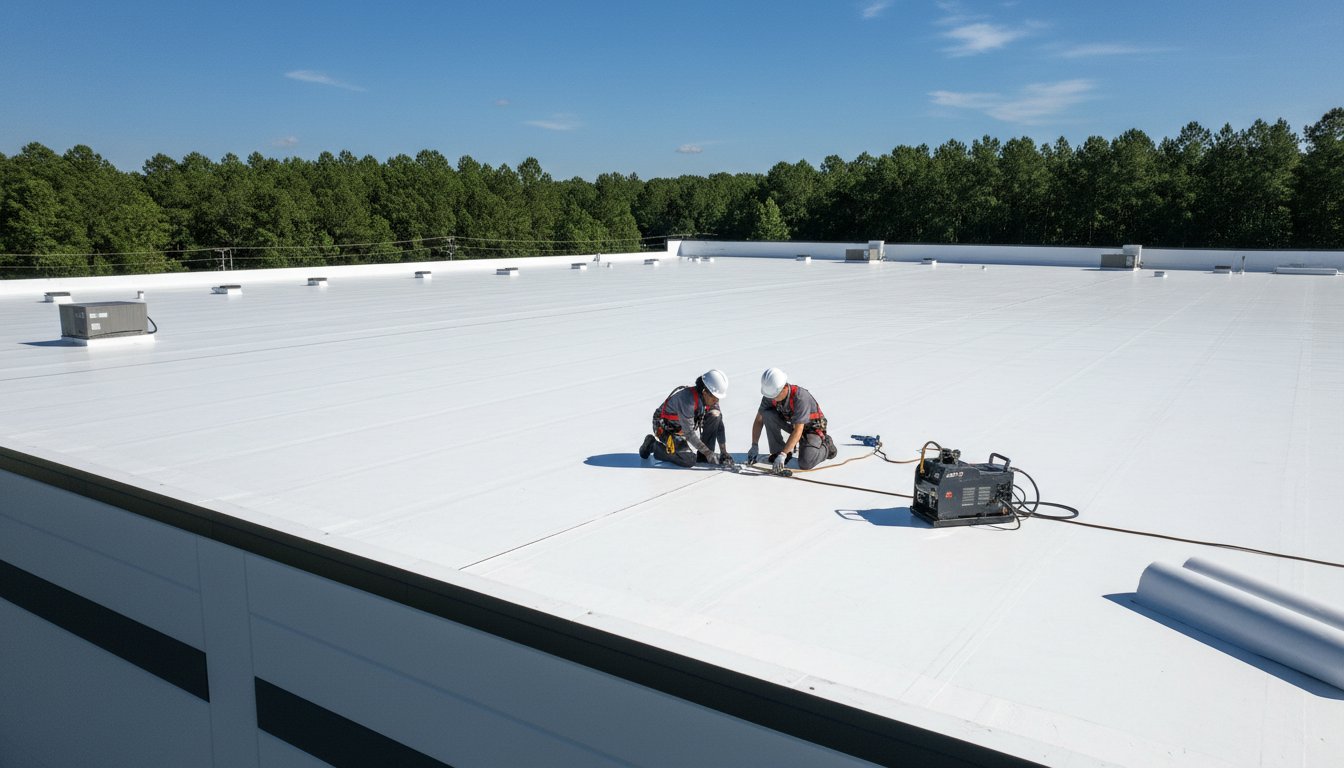
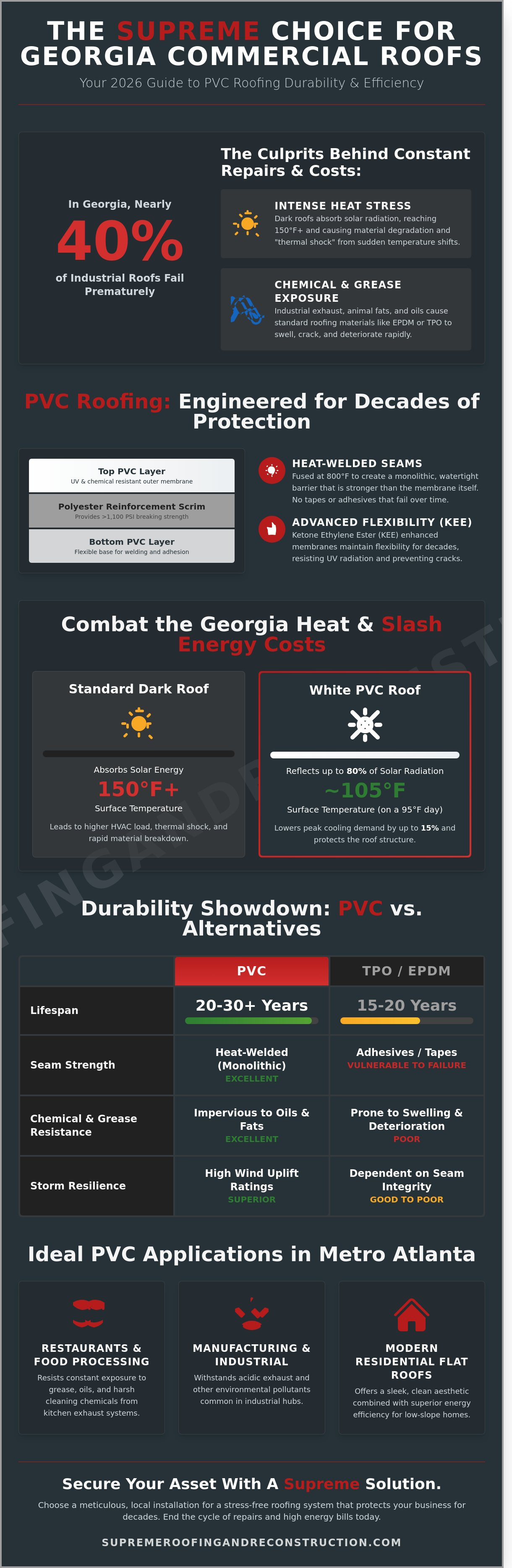
Your commercial roof shouldn't be a recurring line item on your repair budget, yet nearly 40% of Georgia industrial facilities face premature roof failure due to chemical exposure and heat stress. For business owners in Atlanta and Cumming, installing a high quality pvc roofing system is the most effective way to end the constant cycle of patching leaks and paying exorbitant cooling bills. You need a solution that stands up to the intense 95 degree Georgia summers and the harsh grease or chemicals common in industrial environments. We understand that you want a roof that you can install and forget for the next two decades.
In this 2026 guide, we'll demonstrate how this premier material reflects up to 80% of solar radiation to lower your HVAC expenses and provide unmatched resistance to animal fats and industrial exhaust. Supreme Roofing and Reconstruction is here to help you move through these technical choices with confidence and local expertise. By the end of this article, you'll have a clear roadmap to securing a 20 plus year roofing system that protects your assets and your peace of mind.
Key Takeaways
- Understand why specialized commercial environments require chemical-resistant membranes to prevent premature roof failure and maintain structural integrity.
- Discover how high Solar Reflectance Index (SRI) ratings combat Atlanta’s heat island effect to lower your annual cooling costs.
- Compare lifespan and durability to see why pvc roofing often provides a decade more of reliable service than standard TPO or EPDM alternatives.
- Learn the meticulous installation standards and wind uplift ratings required to ensure your property remains resilient against severe Georgia storms.
- Evaluate the long-term ROI of a "Supreme" installation and how choosing a local expert provides a stress-free solution for your business.
What is PVC Roofing and Why is it the "Supreme" Choice for Georgia?
Choosing a commercial roof in the humid, unpredictable climate of North Georgia requires a solution that protects your investment from the inside out. What is PVC Roofing? Polyvinyl Chloride (PVC) is a premium single-ply thermoplastic membrane that has protected commercial assets for over 50 years. It first entered the European market in 1966 and quickly became the gold standard for buildings that demand chemical and grease resistance. While other systems rely on adhesives or tapes that can fail over time, pvc roofing utilizes heat-welded seams. This process fuses the sheets together at temperatures exceeding 800 degrees Fahrenheit, creating a monolithic, watertight barrier that is actually stronger than the membrane itself.
At Supreme Roofing and Reconstruction, we prioritize PVC for facilities where standard materials fall short. If your building features kitchen exhaust fans, chemical vents, or heavy HVAC equipment, PVC is the "Supreme" choice. It remains stable when exposed to animal fats, oils, and industrial chemicals that would cause a TPO or EPDM roof to swell and deteriorate within months. This durability ensures your operations in Atlanta or Cumming continue without the threat of sudden leaks or structural rot.
The Chemistry of a PVC Membrane
The strength of a PVC system lies in its multi-layered construction. Manufacturers embed a high-tenacity polyester reinforcement scrim between two layers of PVC to provide a breaking strength often exceeding 1,100 PSI. PVC roofing is a thermoplastic membrane that uses heat-welded seams for permanent waterproofing. To maintain flexibility, chemists add plasticizers to the mix. For maximum longevity, we often recommend KEE (Ketone Ethylene Ester) enhanced membranes. KEE is a high-molecular-weight polymer that keeps the membrane flexible for decades, even under the intense UV radiation we experience during Georgia summers.
Ideal Applications in Atlanta and Cumming
In the bustling metro Atlanta area, specific industries benefit most from this technology. We focus our PVC installations on the following sectors:
- Restaurants and Food Processing: Facilities in downtown Atlanta and Buckhead rely on PVC to resist grease and oil runoff that eats through other roofing types.
- Manufacturing Hubs: Industrial plants in Gainesville and Lawrenceville utilize PVC for its resistance to chemical exhaust and environmental pollutants.
- Residential Flat Roofs: Modern, low-slope homes in Alpharetta and Milton benefit from the 2026 standards of energy efficiency and the sleek, clean aesthetic of white PVC.
By choosing a pvc roofing system, you are not just buying a product; you are securing a 20 to 30-year solution that withstands the unique environmental stressors of the Southeast. Our team ensures every weld is meticulous, providing the peace of mind that your business is protected by an impenetrable shield.
Engineered for the Southeast: PVC Performance in Georgia Heat
Atlanta’s urban heat island effect isn't just a weather phenomenon; it's a direct threat to your building's lifespan. On a typical 92 degree July afternoon in Fulton County, standard dark roofs can reach temperatures exceeding 150 degrees. PVC membranes solve this by utilizing a high Solar Reflectance Index (SRI). This metric measures a surface's ability to reject solar heat. By reflecting energy rather than absorbing it, PVC keeps the roof surface within 10 to 15 degrees of the ambient air temperature.
This cooling effect prevents the "thermal shock" that often plagues commercial structures in North Georgia. When a sudden 2:00 PM thunderstorm drops the temperature by 20 degrees in minutes, inferior materials expand and contract violently. PVC’s internal reinforcement allows it to withstand these rapid shifts without developing the hairline fractures that lead to leaks. When evaluating PVC roofing benefits, its ability to maintain structural integrity under constant UV stress stands out as a primary advantage for local property owners. It acts as a shield, protecting the underlying insulation and decking from the degrading effects of the intense Georgia sun.
Slashing Energy Costs in the Peach State
A bright white PVC roof reflects up to 80% of solar radiation away from your facility. In John’s Creek, where summer humidity makes HVAC systems work overtime, this reflection translates to a 15% reduction in peak cooling demand. Reducing the load on your rooftop units doesn't just lower your monthly Georgia Power bill; it extends the life of your mechanical equipment. For Cumming businesses looking toward 2026, installing these systems often qualifies for LEED credits and federal energy tax incentives under Section 179D, making the upgrade a smart financial move. If you’re curious about your building's specific savings potential, we can provide a comprehensive energy efficiency audit of your current roof assembly.
Moisture and Humidity Management
Georgia’s 70% average morning humidity creates a breeding ground for mold and algae. PVC membranes are naturally antimicrobial, meaning they don't support the growth of the black streaks often seen on older roofs. This is vital for maintaining the roof's reflective properties over its 20 to 30 year lifespan. During heavy North Georgia downpours, "ponding water" can sit on flat surfaces for 48 hours or more. While other materials might soften or delaminate, PVC’s hot-air welded seams are essentially a single, continuous piece of material that remains watertight even under standing water. We always integrate high-performance vapor barriers into our Southeast assemblies to stop internal condensation from rotting your deck from the inside out.
PVC vs. TPO vs. EPDM: Which is Best for Your Building?
Choosing the right flat roof membrane involves more than just looking at the price tag. For property owners in Atlanta and Cumming, the decision usually comes down to three major players: PVC, TPO, and EPDM. While initial costs vary, the Total Cost of Ownership (TCO) tells a different story. PVC roofing typically offers a service life of 25 to 30 years, which frequently outlasts TPO by 5 to 10 years. This longevity stems from its chemical composition, which remains flexible even after decades of intense Georgia UV exposure.
- Chemical Resistance: PVC is essentially immune to animal fats, grease, and harsh chemicals. This makes it the mandatory choice for restaurants or manufacturing plants where exhaust vents might dump corrosive materials onto the roof.
- Puncture Protection: With a high-tenacity polyester reinforcement scrim, PVC handles regular foot traffic from HVAC technicians better than standard 45-mil TPO membranes.
- Reflectivity: Both PVC and TPO reflect up to 80% of solar radiation, but PVC maintains this reflectivity longer because its surface resists the dirt accumulation that often plagues other systems.
In Georgia, the initial investment for a high-quality PVC system might sit 15% to 20% higher than TPO. However, when you factor in the reduced repair frequency and the extended replacement cycle, the 30-year cost is almost always lower. We see businesses save thousands by avoiding the premature seam failures common in lower-tier installations.
The TPO vs. PVC Debate
TPO currently dominates the warehouse market because it provides a budget-friendly solution for massive footprints. However, specialized facilities require the "Supreme" protection that only PVC delivers. While both systems utilize heat-welded seams, PVC seams are chemically more stable over time. You can learn more about TPO roofing in Atlanta to see if a lower initial investment fits your specific asset management plan. For most high-value commercial assets, we recommend the 60-mil PVC for its unmatched seam integrity.
EPDM: The Rubber Alternative
EPDM is a durable synthetic rubber, but its standard black color is a major liability in the South. During a July afternoon in Cumming, a black EPDM roof can reach 160 degrees, forcing your HVAC units to work 30% harder than they would under a white pvc roofing system. Maintenance is also more intensive; EPDM relies on adhesive tapes and glues that eventually dry out and fail. When comparing durability in storm-prone regions like Opelika, PVC roofing offers superior resistance to wind-driven debris and uplift compared to the adhesive-reliant seams of EPDM systems. Our team focuses on thermoplastic solutions because they offer a seamless, watertight barrier that rubber simply cannot match in our humid, cooling-dominant climate.
Storm Resilience and Installation Excellence in Cumming
Georgia weather doesn't pull punches. With wind gusts in Forsyth County reaching over 60 mph during spring squalls, your commercial roof must act as a shield. At Supreme Roofing and Reconstruction, we treat every pvc roofing project as a mission to secure your investment against the next tornado or tropical remnant. We don't just roll out material; we engineer a defense system starting with the roof deck itself. If the substrate is compromised, the best membrane in the world will fail. We ensure every inch of the deck is dry, level, and structurally sound before the first roll is laid. In Cumming, wind uplift ratings are not just suggestions; they're survival requirements. We install systems designed to withstand 110 mph wind speeds, exceeding many local building codes by 15%.
The 5-Step Supreme Installation Process
Our methodology eliminates guesswork. We follow a rigid protocol to ensure your facility remains leak-free for decades.
- Step 1: Inspection and Substrate Repair: We perform deep-dive assessments in Marietta and Roswell to identify rot or rusted steel decks that require immediate replacement before proceeding.
- Step 2: Precision Insulation: We install high-density cover boards and polyiso insulation to create a smooth, energy-efficient base that prevents ponding water.
- Step 3: Membrane Deployment: We secure the PVC using mechanical fasteners or full-depth adhesives based on your building's specific height and wind exposure.
- Step 4: Robotic and Hand-Welding: Our teams use automated heat-welders for long seams and meticulous hand-welding for complex penetrations, creating a monolithic, waterproof sheet.
- Step 5: Quality Audit: A final 20-point inspection verifies every flashing and edge detail meets our 2026 "Supreme" standard before we issue your warranty certification.
Navigating Storm Damage Claims
When a hailstorm hits North Georgia, the damage to a PVC system isn't always obvious. While traditional roofs show clear bruising, PVC can suffer "star fractures" or microscopic delamination that untrained adjusters often overlook. We step in as your Expert Protector during the insurance process. We provide the technical evidence needed to justify a full restoration rather than a temporary patch. You can learn more about our specialized approach in our guide to storm damage restoration, which explains how we advocate for your property's integrity. Our team handles the complex documentation so you can focus on running your business without the stress of claim denials.
Is PVC Roofing the Right Investment for Your Georgia Property?
Choosing a commercial roof isn't just about covering a building; it's about protecting your bottom line for the next three decades. In the humid, volatile climate of North Georgia, pvc roofing stands out as a premier choice for 2026. It provides a chemical-resistant, fire-rated, and highly reflective barrier that performs consistently under the intense Atlanta sun. While the initial cost per square foot might be higher than TPO or EPDM, the long-term value is undeniable. You aren't just buying a membrane; you're investing in a system that resists punctures and remains weldable even as it ages.
To reach that 30-year milestone, your maintenance strategy must be proactive. We recommend scheduled inspections every March and October. During these visits, our technicians clear debris from scuppers, check for ponding water, and ensure the heat-welded seams remain airtight. This meticulous approach prevents minor issues from becoming 10,000 dollar repairs down the road. Our "Supreme" standard ensures that every technical detail, from flashing to curb wraps, meets rigorous local codes and manufacturer specifications. We don't cut corners because we know that a single weak seam can compromise an entire facility.
Calculating Your ROI
Your return on investment comes from three primary channels. First, the high solar reflectivity can slash cooling costs by 25% to 30% during the peak heat of July and August. Second, the durability of the material reduces emergency leak repairs by nearly 40% compared to older asphalt systems. Finally, a "Supreme" warranty offers local accountability that national contractors simply can't match. For a deeper dive into how different systems compare across the state, explore our Complete 2026 Commercial Roofing Guide.
Schedule Your Supreme Inspection
Our team serves business owners throughout Atlanta, Cumming, and Alpharetta with a commitment to excellence. We've refined a stress-free replacement process that minimizes disruption to your daily operations. You'll work with a steady hand who understands both the technical requirements of pvc roofing and the nuances of Georgia insurance claims. We position ourselves as your expert protector, ensuring your asset is shielded from the elements. Don't wait for a visible leak to compromise your inventory or workspace. Take the first step toward a permanent, high-performance solution today.
Ready to secure your facility with a local ally? Get Your Supreme PVC Roofing Quote Today and experience the difference of a team that treats your property with genuine integrity.
Future-Proof Your Georgia Business with Supreme Performance
As we move into 2026, commercial property owners in Atlanta and Cumming face a clear choice for long-term asset protection. Choosing pvc roofing provides a heat-reflective barrier that handles 100-degree Georgia summers and resists chemical exposure better than other single-ply membranes. These systems aren't just durable; they're engineered to lower cooling costs by up to 40% while offering a 30-year lifespan that outlasts TPO and EPDM alternatives. You need a roof that works as hard as your business does.
Supreme Roofing and Reconstruction brings over 15 years of local Georgia and Alabama expertise to your job site. We serve as your specialized storm damage advocates, ensuring your investment stays protected from the first gust of wind to the final inspection. Our team executes a meticulous 20-point installation audit on every project to guarantee that every seam and flashing exceeds industry standards. It's time to stop worrying about leaks and start focusing on your growth.
Secure Your Business with a Supreme PVC Roof Quote
We're ready to provide the steady hand and expert craftsmanship your building requires for a stress-free, permanent roofing solution.
Frequently Asked Questions About PVC Roofing
How much does a PVC roof cost per square foot in Georgia?
Business owners in Atlanta and Cumming should budget between $10.00 and $15.00 per square foot for a professional PVC roofing installation in 2026. This price includes high-quality 60-mil membrane materials and expert labor. While the initial investment sits about 20% higher than TPO, the long-term energy savings and durability often provide a full return on investment within 8 years.
How long does a PVC roofing system typically last in the Southeast?
A professionally installed PVC roofing system typically lasts 20 to 30 years in the intense humidity and heat of the Southeast. The reinforced membranes are engineered to resist the high UV index and thermal shock common during Georgia summers. We have seen well-maintained commercial systems reach the 35-year mark, providing a reliable shield for your property through decades of unpredictable weather.
Can PVC roofing be installed over an existing roof?
You can often install a PVC membrane directly over an existing roof if the current structure has only one layer and the insulation is dry. This "roof recover" process saves you approximately $2.50 per square foot in tear-off and disposal fees. Our technicians perform a thermal moisture scan to ensure your building qualifies for this code-compliant, cost-effective solution before we begin work.
Is PVC roofing resistant to hail damage from Georgia storms?
PVC roofing is exceptionally resistant to hail because of its flexible, polyester-reinforced design. Most premium membranes carry a Class 4 impact rating, which is the highest protection level available in the construction industry. This rating means your roof can withstand 2-inch hailstones without puncturing; this durability often leads to a 15% reduction in commercial insurance premiums for local business owners.
What is the difference between PVC and TPO roofing?
The primary difference lies in chemical resistance and long-term flexibility. PVC contains specialized plasticizers that keep the material pliable for decades, whereas TPO is a more rigid, rubber-based product. If your building houses a restaurant or manufacturing plant, PVC is the superior choice because it resists animal fats, grease, and chemicals that would degrade a TPO surface in less than 5 years.
Does PVC roofing require a lot of maintenance?
PVC requires very little maintenance beyond a biannual inspection and basic debris removal from drainage points. We recommend checking your heat-welded seams every 6 months to ensure the integrity of the watertight seal remains perfect. This proactive, "Supreme" approach prevents 90% of common leaks and keeps your manufacturer warranty fully intact without the need for expensive coatings or frequent repairs.
Can I install solar panels on a PVC roof in Atlanta?
You can absolutely install solar panels on a PVC roof, and the white, reflective surface actually increases solar efficiency by up to 10% by keeping the panels cooler. We utilize specialized non-penetrating mounting systems that weld directly to the membrane surface. This method ensures your 20-year warranty remains valid while you generate clean, renewable energy for your Atlanta business operations.
Is PVC roofing environmentally friendly or recyclable?
PVC is a sustainable choice because it is 100% recyclable at the end of its service life. Industry programs have successfully recycled over 1 billion pounds of vinyl since the 1990s. Its high solar reflectance index (SRI) of 100 or more helps mitigate the "urban heat island" effect in metro Atlanta, which can lower your building's annual cooling costs by 25% or more.