A single afternoon of Georgia hail can compromise a standard flat roof, but epdm roofing is engineered to treat severe weather as a minor inconvenience. You've likely felt the stress of watching Atlanta temperatures climb past 95 degrees while your cooling system struggles to keep up. It's a common frustration for the 60% of property owners in Cumming who want to protect their investment without facing constant repair cycles or skyrocketing utility bills. You deserve a solution that offers unmatched durability and a clear path to long-term savings.
This guide demonstrates why EPDM remains the Expert Protector for local commercial properties, providing a meticulous shield against the elements through 2026 and beyond. We'll break down the technical differences between EPDM, TPO, and PVC so you can make a confident decision for your building. You'll also learn how our Supreme standards simplify the insurance process, ensuring a leak-free result and a truly stress-free installation experience from start to finish.
Key Takeaways
- Understand why epdm roofing serves as the "Expert Protector" for Georgia commercial properties, providing meticulous durability against severe hail and wind.
- Discover how unmatched material flexibility ensures your flat roof expands and contracts seamlessly during North Georgia’s rapid temperature shifts.
- Evaluate the energy-saving benefits of black versus white membranes to choose the most cost-effective "Cool Roof" solution for your specific climate needs.
- Learn the essential steps of a professional installation process that guarantees a wrinkle-free, high-integrity substrate for long-term protection.
- Gain confidence in navigating storm damage claims with a local partner who combines technical expertise with a proactive approach to insurance.
What is EPDM Roofing? The "Expert Protector" for Flat Roofs
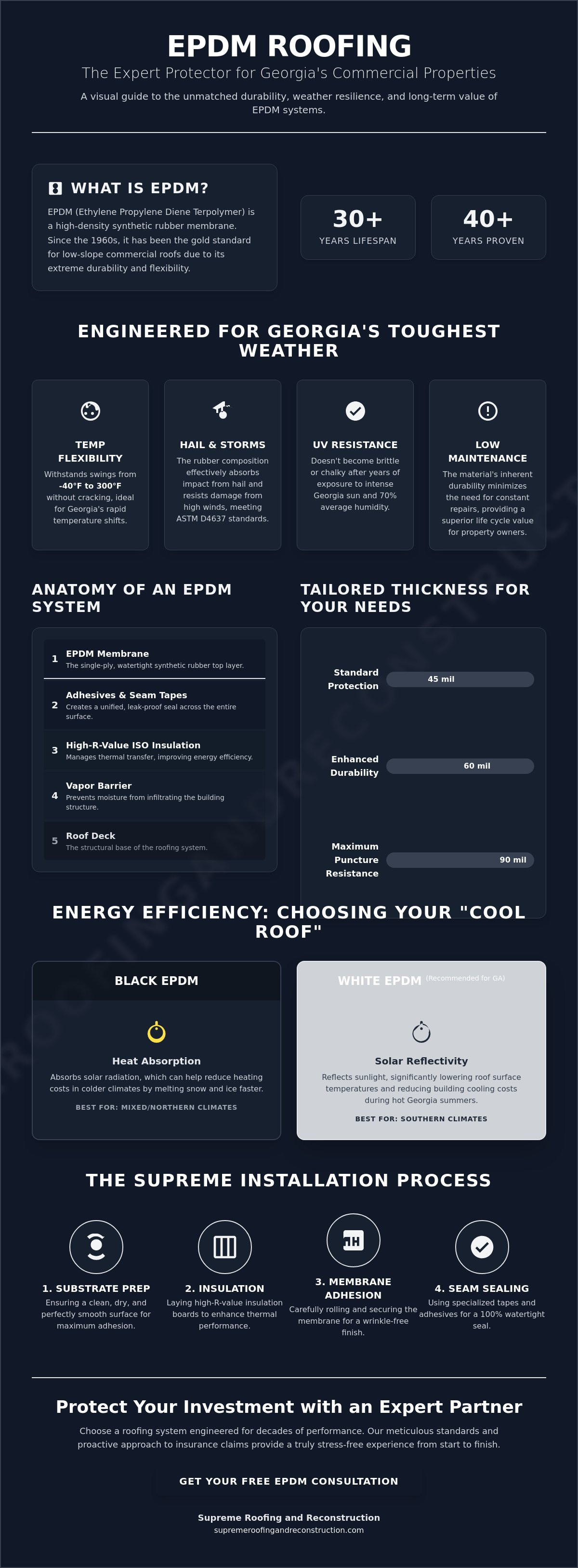
EPDM stands for Ethylene Propylene Diene Terpolymer. It is a high-density synthetic rubber that has served as the gold standard for the commercial sector since the early 1960s. For over 40 years, it's been the primary choice for low-slope and flat commercial buildings across the United States. To understand the technical chemistry behind this material, you can explore What is EPDM rubber to see how its molecular structure provides such extreme durability. This material is specifically engineered to withstand extreme temperature fluctuations. It can handle swings from -40°F to 300°F without cracking or degrading. We typically offer this membrane in three standard thicknesses: 45 mil, 60 mil, and 90 mil. The 90 mil option provides the highest level of puncture resistance for roofs that require frequent maintenance access.
The Anatomy of a Rubber Roof System
An EPDM system is more than just a sheet of rubber; it's a meticulously engineered shield. The epdm roofing membrane is secured using specialized adhesives or seam tapes that create a unified, watertight seal. Unlike traditional built-up roofing (BUR) or modified bitumen which rely on multiple layers of asphalt, EPDM is a single-ply system. This makes it lighter and more flexible during building expansion. A high-performance installation also includes high-R-value polyisocyanurate (ISO) insulation boards and vapor barriers. These components work together to manage thermal transfer and prevent moisture from infiltrating your building's structure.
Why Georgia Businesses Choose EPDM
In Georgia, the climate presents unique challenges that demand a sturdy solution. Business owners in Cumming and Alpharetta face 70% average morning humidity and intense solar radiation. EPDM excels in these environments because of its exceptional UV resistance. It doesn't become brittle or chalky after years of exposure to the Georgia sun. We've seen these systems maintain their structural integrity for 25 to 30 years when installed to our meticulous standards. This proven performance is why it remains a cornerstone of our commercial roofing services. It provides a stress-free solution for property managers who need a roof that performs as hard as they do. When you choose epdm roofing, you're investing in a long-term ally for your facility's protection.
Key Benefits: Why EPDM Excels in the Georgia Climate
Atlanta business owners face a punishing climate. From 100-degree summer afternoons to sudden North Georgia hail, your facility's roof takes a constant beating. EPDM roofing provides a meticulous defense because it's specifically engineered for these extremes. Its rubberized composition allows the membrane to expand and contract during rapid temperature shifts, preventing the fractures often seen in rigid systems. This flexibility makes it a premier choice for large commercial footprints where structural movement is inevitable. By choosing a material that moves with your building, you eliminate the stress of premature fatigue and leaks.
Storm Resilience and Hail Protection
North Georgia storm seasons bring unpredictable winds and heavy hail that can devastate commercial properties. Unlike brittle materials that shatter or crack under impact, the rubberized nature of EPDM absorbs energy effectively. We've seen this resilience firsthand during our storm damage restoration work throughout Cumming and the surrounding areas. To ensure this performance, modern membranes must meet the ASTM D4637 standard which dictates the minimum requirements for tensile strength and tear resistance in vulcanized rubber. This standard ensures your facility remains watertight even when the weather turns violent, protecting your inventory and operations from water intrusion.
Longevity and Life Cycle Value
Choosing a roof for a large commercial footprint requires a sharp focus on long-term ROI. EPDM stands out as one of the most cost-effective solutions for expansive buildings. Data from the EPDM Roofing Association shows that these systems consistently outperform competitors in life cycle costs and environmental impact. You can expect a lifespan of 25 to 30 years or more when the installation follows the "Supreme" standard of precision. Maintenance requirements stay low because the material naturally resists UV radiation and thermal shock.
The ease of repair is another major factor in its life cycle value. Unlike thermoplastic systems that require complex heat-welding, EPDM repairs use advanced primers and pressure-sensitive tapes. This creates a chemical bond that's often stronger than the original field membrane. If a small puncture occurs from flying debris or heavy foot traffic, our team can perform seamless patches without replacing entire sections. This localized approach saves you thousands in potential replacement costs over the decades. If you're planning a renovation or new build, you can consult with our commercial specialists to see if EPDM fits your building's specific needs. We focus on getting the job done right the first time so you can focus on running your business.
EPDM Color Options: Black vs. White for Energy Efficiency
Traditional black epdm roofing has served as a reliable industry standard for over 50 years. It excels in northern climates by absorbing heat to melt snow and ice, but in the 90 degree Atlanta summers, it can push roof surface temperatures above 150 degrees. This heat transfer forces your HVAC units to work harder, which increases your monthly operational costs. According to the EPDM Roofing Association, this material is a durable synthetic rubber that provides long term weather resistance regardless of color. For Cumming business owners, white EPDM offers a "Cool Roof" advantage. This reflective membrane bounces back up to 80 percent of solar radiation. By keeping the roof surface cooler, you reduce the internal building temperature and extend the lifespan of your cooling equipment. Your choice also dictates your commercial roof maintenance schedule. White membranes require more frequent cleaning to maintain their high reflectivity ratings, as dirt accumulation can diminish their energy saving benefits over time.The Energy Impact of a Cool Roof
Thermal emissivity measures how efficiently a surface sheds absorbed heat. In Georgia, high emissivity is vital for lowering utility bills. White EPDM performs similarly to TPO roofing in its ability to reflect UV rays, though EPDM remains more flexible in fluctuating temperatures. Local building codes in Marietta and Roswell are increasingly pushing for high-reflectance materials for new commercial constructions to meet 2026 energy standards. Choosing a white membrane often provides a faster ROI through immediate energy savings during our humid, five month cooling season.
EPDM vs. PVC Roofing: A Quick Comparison
While epdm roofing offers unmatched flexibility and impact resistance, it may not be the right fit for every facility. For example, restaurants in the Atlanta metro area often prefer PVC roofing because it resists animal fats and grease better than rubber. However, for large scale warehouses or office parks, EPDM provides a more cost effective, seamless solution. We recommend EPDM for facilities where structural movement is expected, as the rubber can stretch and return to its original shape without cracking. Our team ensures your membrane choice aligns with your specific industry requirements and local environmental stressors.
- Black EPDM: Best for buildings with high winter heating needs or those seeking the lowest initial installation cost.
- White EPDM: Ideal for retail centers and offices looking to slash summer cooling costs by up to 15 percent.
- Climate Factor: Atlanta's 217 sunny days per year make reflective surfaces a proactive choice for property protection.
The Installation Process: What to Expect
A successful epdm roofing project depends on a disciplined, five-step execution. Our crews follow a rigorous protocol to ensure your investment remains watertight for decades. We don't cut corners because we know that a commercial roof is only as strong as its weakest seam. Our process eliminates the stress of property management by getting the job done right the first time.
- Step 1: Meticulous Surface Preparation. We begin by clearing the deck of all debris, dust, and moisture. A clean, dry substrate is non-negotiable for proper adhesion.
- Step 2: Precise Layout and Relaxation. EPDM has "memory" from being tightly rolled. We lay the sheets out and let them rest for at least 30 to 45 minutes. This prevents the membrane from shrinking or wrinkling after it's secured.
- Step 3: Secure Attachment. Depending on your building's engineering, we utilize fully adhered, mechanically attached, or ballasted methods to lock the system in place.
- Step 4: Critical Seam Sealing. This is the most vital phase. We use specialized primers and factory-applied tapes to create a chemical weld between sheets, ensuring a permanent, watertight finish.
- Step 5: Final Inspection and Detailing. We hand-check every inch of flashing around vents, pipes, and parapet walls. This final walkthrough ensures the "Supreme" standard of quality is met.
Choosing the Right Attachment Method
The wind loads in Gainesville and Lawrenceville demand specific engineering choices. For high-wind areas, the Fully Adhered method is the gold standard. We apply bonding adhesive to the entire surface for maximum uplift resistance. If you own a large, open-deck warehouse, Mechanically Attached systems offer a cost-effective solution using heavy-duty fasteners. Ballasted systems, which use river rock to hold the membrane, are less common in modern 2026 Georgia builds but remain an option for specific structural designs.
Common Installation Pitfalls to Avoid
Poor craftsmanship often leads to "bridging," where the membrane is pulled too tight at wall transitions. This tension eventually causes the material to pull away from the roof deck. Supreme Roofing prevents this by ensuring the material follows the exact contour of every angle. We also prioritize seam cleanliness. Even a small amount of dust can lead to premature failure. Our team maintains "Supreme" integrity by double-checking every bond. It's also vital to maintain commercial roof repair awareness during your first year. Minor building settling can occur, and catching small adjustments early protects your long-term epdm roofing warranty.
Protect your commercial investment with a team that values precision and local accountability. Contact Supreme Roofing and Reconstruction for a detailed installation quote today.
Supreme Quality: Your Local EPDM Expert in Georgia
Supreme Roofing and Reconstruction serves as your dedicated partner for epdm roofing across the Atlanta metro area and Cumming. We understand Georgia's volatile weather because we live here. When a 60 mph wind gust or a sudden hailstorm compromises your facility, you need a team that arrives fast and works with precision. Our local roots mean we're familiar with the specific building codes and environmental stressors unique to Forsyth and Fulton counties. We don't just install roofs; we build defenses for your livelihood.
Our "Supreme" standard dictates every action we take. We select only high-performance membranes that exceed industry minimums for tensile strength and UV resistance. This meticulous approach prevents premature degradation and keeps your interior dry for decades. Our crews follow a rigorous 12-point inspection protocol during every installation to ensure seams are airtight and flashing is secure. We manage every detail of the project, from the initial safety perimeter setup to the final site cleanup. You stay focused on running your business while we handle the heavy lifting. Our goal is a seamless transition that restores your operations with zero downtime.
Navigating Insurance Claims for Commercial Roofs
Storm damage often leaves business owners feeling overwhelmed by red tape. Our team acts as your expert advocate during these high-stress periods. We document every puncture, tear, and compromised seam with high-resolution imagery and detailed structural reports. This evidence helps adjusters see the full scope of the damage without any ambiguity. We ensure your epdm roofing replacement meets the specific requirements of your commercial policy. You won't have to face the restoration paperwork alone. We provide a steady hand to guide you through the entire claims process, securing the coverage you deserve for a full recovery.
Schedule Your Supreme Inspection Today
Your facility deserves a roof that performs without compromise. We invite you to schedule a comprehensive evaluation of your current flat roof system today. Our experts provide a deep-dive analysis of your roof's integrity, identifying hidden leaks before they become costly disasters. We deliver customized quotes tailored to your property’s square footage and your specific budgetary goals. Building a long-term partnership means we're here for your safety today and your facility's growth tomorrow. Contact our Cumming office or our Atlanta team to secure your property with a Supreme solution that stands the test of time.
Secure Your Commercial Investment for 2026 and Beyond
Your commercial property deserves a defense system that stands up to the unpredictable Georgia weather. Choosing epdm roofing provides a durable, cost-effective solution that handles extreme heat and sudden storms with ease. By selecting the right membrane color for your energy goals and ensuring a meticulous installation, you're investing in decades of reliable protection. Supreme Roofing and Reconstruction brings over 10 years of Georgia storm restoration experience to every project we handle in the Atlanta and Cumming areas. We don't just lay material; we implement "Supreme" craftsmanship standards that exceed basic industry requirements. Our team also provides expert assistance with commercial insurance claims to ensure you're never navigating complex adjusters or paperwork alone. We've built our reputation on being a local ally for business owners who value transparency and results. You can trust our steady hand to deliver a permanent, high-quality solution for your facility. It's time to gain the peace of mind that comes with a roof built to last.
Contact Supreme Roofing and Reconstruction for a Stress-Free EPDM Quote
We look forward to protecting your business with the excellence and integrity it deserves.
Frequently Asked Questions
How long does an EPDM roof typically last in Georgia?
An EPDM roof typically lasts between 25 and 30 years when installed by professionals in the North Georgia climate. The synthetic rubber material resists UV radiation and thermal shock, which is vital for Atlanta's 90 degree summer days. Regular inspections ensure the seams remain watertight, extending the system's life beyond the three decade mark in many local commercial applications.
Is EPDM roofing better than TPO for commercial buildings?
Choosing between EPDM and TPO depends on your building's specific thermal needs and expected foot traffic. While TPO offers high reflectivity, epdm roofing provides superior resistance to hail and extreme temperature fluctuations. EPDM membranes don't become brittle over time, making them a reliable choice for Atlanta business owners who prioritize long term durability over initial cooling costs.
Can EPDM roofing be installed over an existing roof?
You can often install EPDM over an existing roof if the current substrate is dry and structurally sound. Georgia building codes generally allow for a maximum of two roofing layers on a commercial structure. Our team conducts moisture scans to ensure no trapped water exists, as adding a new membrane over wet insulation leads to premature failure and deck rot.
How much does EPDM roofing cost per square foot in Atlanta?
Commercial roofing costs in the Southeast vary based on membrane thickness and specific attachment methods. Industry data from 2024 suggests national averages for EPDM installations range from $5.00 to $12.00 per square foot. Local factors like building height, insulation requirements, and the complexity of roof penetrations will determine the final investment for your Cumming or Atlanta property.
Is EPDM roofing resistant to hail damage?
EPDM is exceptionally resistant to hail damage due to its inherent elasticity and rubber composition. UL 2218 Class 4 impact ratings are common for ballasted or thick mil EPDM systems. This resilience protects your facility during Georgia's spring storm season, where hail stones frequently exceed 1 inch in diameter, causing catastrophic failure in less flexible materials.
Does a black rubber roof make a building hotter in the summer?
A standard black EPDM membrane absorbs more solar heat, which can increase surface temperatures to 150 degrees Fahrenheit. We mitigate this by applying white acrylic coatings or using light colored river stone ballast. These additions reflect up to 85 percent of solar radiation, keeping your cooling costs manageable during intense Atlanta summers while maintaining the roof's durability.
What kind of maintenance does an EPDM roof require?
EPDM roofs require bi-annual inspections to identify debris accumulation and seam stress. We focus on clearing internal drains and scuppers to prevent ponding water, which can weigh down your structure. Checking the integrity of perimeter flashing and sealants every six months prevents minor shifts from turning into costly interior water damage for your business.
Can I walk on my EPDM roof for equipment maintenance?
You can walk on an EPDM roof, but high traffic areas around HVAC units require dedicated walk pads. These reinforced pads protect the membrane from accidental punctures and tool drops during routine equipment service. Limiting foot traffic to these designated paths ensures your epdm roofing remains puncture free and maintains its manufacturer warranty for the full term.